The BPD Compass Companion
The BPD Compass Companion
Understand your patterns. Learn the skills. Find your path forward.
Learn directly from BPD Compass developer Dr. Shannon Sauer-Zavala as she guides you step by step through this personalized, evidence-based approach to BPD.
Short video lessons. Practical exercises. Skills you can start using right away.
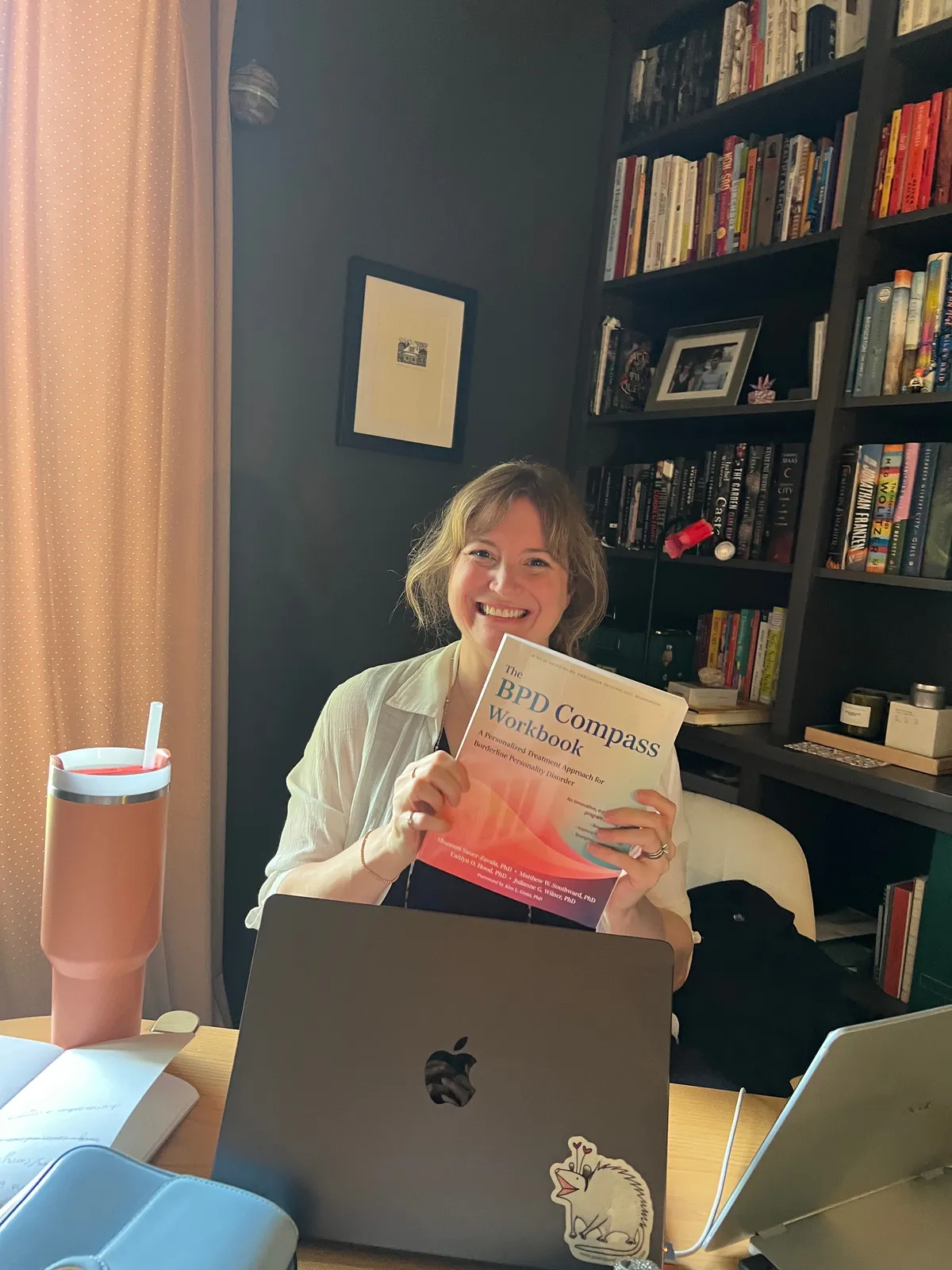
BPD can look different for everyone. Your path forward should, too.
Maybe your emotions go from 0 to 100 before you know what happened.
Maybe relationships are where you struggle most—with trust, vulnerability, conflict, or fears of being left behind.
Or maybe you find yourself acting on urges in the moment, even when you know you'll regret it later.
For some, it's some combination of all three.
BPD Compass doesn't assume that everyone’s path to recovery looks the same.
Instead, you'll learn what's driving your symptoms so you can point your Compass toward the skills that matter most for you.
A New Way To Understand BPD
There are nine symptoms of BPD, and there are 256 different combinations of those symptoms that can lead to the same diagnosis. So why would we expect the exact same set of skills to work for everyone?
BPD Compass takes a different approach. Instead of asking you to master a long list of skills just because you have BPD, you'll learn to look underneath your symptoms and identify the patterns that are driving them.
BPD Compass focuses on three:
🌊
Negative Emotions
You experience emotions intensely or find yourself doing almost anything to make difficult feelings go away.
🤝
Relationship Difficulties
Patterns involving trust, vulnerability, conflict, or fear of losing people make it hard to build the relationships you want.
⚡
Impulsivity
What feels urgent or rewarding right now can take over—even when it conflicts with what you want in the long run.
Your combination is your Compass through the program.
Once you have a clear path, you can stop trying to change everything and start focusing on the skills that make sense for you.
Picture What Could Change
You don't need a formal BPD diagnosis to benefit from BPD Compass.
The program was developed for people with BPD, but the patterns it targets—intense negative emotions, relationship difficulties, and impulsivity—can get in the way even if you don't meet the criteria for a diagnosis.
BPD Compass can help you learn to…
✨ Experience strong emotions without being controlled by them. Feel anxious, angry, ashamed, or sad without needing to immediately escape or act on it.
✨ Build closer, more genuine relationships. Practice trusting others, letting yourself be vulnerable, asking for what you need, and handling conflict differently.
✨ Make choices you'll feel good about later. Create space between an urge and an action so what feels good right now doesn't derail what matters to you in the long run.
✨ Feel more confident handling difficult moments. Know what patterns tend to get you off course—and have skills you can turn to when they show up.
✨ Build a life that's guided more by what matters to you. Use your values to make choices about how you want to show up in your relationships, work, health, and other important parts of your life.
You don't need a diagnosis to know you'd like something in your life to be different.
BPD Compass can help you learn to…

✨ Experience strong emotions without being controlled by them. Feel anxious, angry, ashamed, or sad without needing to immediately escape or act on it.
✨ Build closer, more genuine relationships. Practice trusting others, letting yourself be vulnerable, asking for what you need, and handling conflict differently.
✨ Make choices you'll feel good about later. Create space between an urge and an action so what feels good right now doesn't derail what matters to you in the long run.
✨ Feel more confident handling difficult moments. Know what patterns tend to get you off course—and have skills you can turn to when they show up.
✨ Build a life that's guided more by what matters to you. Use your values to make choices about how you want to show up in your relationships, work, health, and other important parts of your life.
You don't need a diagnosis to know you'd like something in your life to be different.
What's inside
Six modules. Your personalized path through BPD Compass.
This is a choose your own adventure program—focusing on the skills for Negative Emotions, Relationship Difficulties, and Impulsivity that are most relevant to you.
You don't need to master every skill or change everything at once. The point of a personalized approach is to spend your time practicing the skills most likely to help you.
Module 1: Understand BPD Differently
Learn why BPD can look so different from one person to another—and how looking beneath individual symptoms can give you a clearer way forward.
You'll be introduced to the three patterns at the heart of BPD Compass: Negative Emotions, Relationship Difficulties, and Impulsivity.
Module 2: Build Your Compass
Before you decide what to work on, you need to know where you want to go.
You'll identify what matters most to you, clarify the changes you want to make, and build your personal Compass to help you decide where to focus your efforts. You'll also learn how to track your progress along the way.
Module 3: Change Your Relationship With Difficult Emotions
Strong emotions aren't something you need to eliminate.
You'll learn to recognize the ways you may be fighting, escaping, or reacting to difficult emotions—and practice experiencing them without automatically letting them determine what you do next.
Module 4: Build Stronger Relationships
Learn how your patterns around trust and vulnerability can keep you from the connection you want.
You'll practice letting down walls, building trust, communicating what you need, and staying engaged with other people even when relationships feel uncomfortable.
Module 5: Make Choices With the Future in Mind
Strong urges can make what you want right now feel much more important than what you want in the long run.
You'll learn to create space between an urge and an action, ride out urges without immediately acting on them, and make choices that move you toward the life you actually want.
Module 6: Keep Moving Forward
Take stock of what's changed, identify the skills that have been most useful for you, and decide where you want to keep practicing.
You'll leave with a plan for continuing to use your Compass when old patterns show up again.
Everything you need to put BPD Compass into practice
This isn't hours of lectures about BPD. It's a practical, self-paced course designed to help you understand the skills, try them out, and use them in your own life.
▶ Short, focused video lessons
Learn directly from Dr. Shannon Sauer-Zavala as she breaks down BPD Compass concepts and skills into clear lessons you can start using right away.
✎ Guided exercises
Fillable worksheets help you make the material personal—identifying your patterns, practicing new responses, and applying the skills to situations in your actual life.
🧭 A personalized path
Your Compass helps you decide where to focus, so you can spend your time on the skills that are most relevant to you instead of working through material you don't need.
∞ Lifetime, self-paced access
Take time to practice. Rewatch a lesson when you need it. Return to the course for a refresher when an old pattern starts showing up again.
Already have The BPD Compass Workbook?
Perfect. This program was designed to help you get even more out of it.
Think of the workbook as your in-depth guide to BPD Compass—and the course as having me alongside you, explaining the key ideas, walking you through the skills, and helping you figure out where to focus.
Use the two together for the fullest BPD Compass experience.
Don't have the workbook?
That's okay, too. This course includes everything you need to follow the program and practice the core skills on its own.

Dr. Shannon Sauer-Zavala: The Mission Behind BPD Compass
I'm Dr. Shannon Sauer-Zavala, a clinical psychologist, researcher, and the lead developer of BPD Compass.
I've spent much of my career thinking about how we can make effective mental health treatment more efficient, personalized, and accessible.
That's especially important for BPD. We know BPD is treatable, but many people still have difficulty finding therapists who are trained—or willing—to treat it. And the specialized treatments that are available can require significant time, money, and resources.
I developed BPD Compass to offer another way forward: a focused approach that identifies the patterns driving your symptoms and targets them with practical, evidence-based skills.
Then my coauthors and I created The BPD Compass Workbook to make those strategies available to people who might never have access to specialized BPD treatment.
The Companion Course is the next step in that mission.
I wanted to offer more support for people who would benefit from having someone explain the concepts, demonstrate the skills, and help them make sense of how the pieces fit together.
Think of it as having the developer of BPD Compass alongside you as you learn the approach—without needing to be in my therapy office.
My hope is simple: that where you live, what treatment is available near you, or whether you can find a BPD specialist shouldn't determine whether you can access tools that can help.
Ready to find your path forward?
The BPD Compass Companion
Lifetime access to the complete self-paced program:
Six guided course modules
Short video lessons with Dr. Shannon Sauer-Zavala
Fillable exercises to apply the skills to your life
A personalized path based on your BPD Compass
Lifetime access, revisit the material whenever you need it
$99 $120
one-time or 4 payments of $30
Cost getting in the way?
We want BPD Compass to be accessible to people who might not otherwise have these resources. If the standard price would be a meaningful financial barrier, reduced-cost access is available.
Praise for BPD Compass
David H. Barlow, PhD
What has been missing for clinicians is an approach to treatment for BPD that personalizes intervention for each individual patient. The BPD COMPASS approach does just that, and in a user-friendly manner that will be invaluable to clinicians.
Jennifer Cheavens, PhD
This team of outstanding clinical researchers has developed a triple-threat – evidence-based, accessible, and personalized - intervention for BPD with the COMPASS manual. First, they provide readers with a straight-forward, warm, and actionable manual based on years of their research. Second, they put the treatment in the hands of clients. Finally, the personalized therapy allows every client to create a path forward that works for them. This is an excellent contribution to the BPD treatment toolbox.

Melanie Goldman, R.P.
One tool that truly resonated with me is the Relationship Compass. I plan to utilize it both with my clients and for my own personal development to clarify my values, identify my needs and wants, and navigate relationships with intention.
What Clients Are Saying...
I just want to say that this treatment has changed many relationships in my life and I am grateful to have been a part of it. I think everyone should know and practice these skills and I so pleasantly surprised at the course of therapy as a whole and at myself. Thank you to Shannon. What you do here changes lives and I want you to know it means something.
Former Client
Shannon was wonderful. I felt seen, heard and understood. I love that this option came open. For someone who doesn't qualify for inpatient/intensive outpatient or is unable to go for, this treatment was great. It gave all the tools I was lacking and I am so grateful.
Former Client
Thank you! This could help those with BPD who have gone through a topsy-turvy life. Shannon has been the best therapist I've had. I knew I could always be honest with her when talking about my internal struggles.
Former Client
Working with Shannon was powerful and made BPD less scary. My anxiety has decreased tremendously by giving me tools to address the thoughts that had been running wild convincing me I was terrible.
Former Client
Shannon helped me realize I can shape who I am and what I value and also to stop running from emotional distress by doing things that are outside of the life I am shaping.
Former Client
Important: This Course Is Not Therapy
The BPD Compass Companion is a self-guided educational program designed to teach you about the BPD Compass approach and provide practical skills you can apply in your own life.
The course is not psychotherapy, medical or mental health treatment, crisis care, or a substitute for care from a qualified mental health professional. Participating in the course does not establish a therapist-client relationship with Dr. Shannon Sauer-Zavala or any other BPD Compass developer, author, or affiliated organization.
The course does not provide individualized diagnosis, assessment, treatment recommendations, or monitoring of your symptoms or safety. If you have questions about whether these strategies are appropriate for you, please discuss them with a qualified mental health professional.
You may use the course alongside therapy or other mental health treatment. Your treating professional remains responsible for any individualized clinical recommendations or care they provide.
This course is not designed to respond to emergencies or mental health crises. Course materials, forms, messages, or other course features should not be used to request emergency assistance or crisis support.
If you are in immediate danger, are thinking about suicide or seriously harming yourself or someone else, or otherwise need immediate support, contact emergency services or an appropriate crisis service in your location.
Frequently Asked Questions
Do I need to have BPD to take the course?
No. BPD Compass was developed for people with borderline personality disorder, but you don't need a formal diagnosis to benefit from the course.
If you struggle with intense emotions, difficulties with trust or relationships, impulsive behavior—or some combination of the three—the BPD Compass approach may be useful for you.
Do I need The BPD Compass Workbook?
No. Everything you need to complete the course is included.
If you already have The BPD Compass Workbook, though, the two work well together. The workbook lets you go deeper into the concepts and includes additional opportunities for practice, while the course gives you the experience of having Dr. Shannon Sauer-Zavala guide you through the approach.
Does BPD Compass work?
BPD Compass has been tested in clinical research with adults with BPD. In a randomized controlled trial, people who received the 18-session BPD Compass treatment showed large reductions in BPD symptoms, along with improvements in the personality patterns the treatment was designed to target.
Research has also found improvements in commonly co-occurring problems, including depression, anxiety, and PTSD symptoms.
It's important to note that this research tested BPD Compass delivered as psychotherapy with a therapist. The self-guided course itself has not been tested in a clinical trial, so we can't assume that working through the course independently will produce the same results.
The Guided Course teaches the BPD Compass framework and core skills in a format designed to make them easier to access and practice on your own.
Is this course therapy?
No. The BPD Compass Companion is a self-guided educational program, not psychotherapy or individualized mental health treatment. Enrolling in the course does not establish a therapist-client relationship with Dr. Sauer-Zavala or any other BPD Compass developer or author.
If you need individualized assessment, treatment, or support, please work with a qualified mental health professional.
Can I use the course while I'm seeing a therapist?
Absolutely. You can work through BPD Compass alongside therapy and bring what you're learning into your sessions.
Your therapist may also be able to help you think about how the skills apply to your particular circumstances. The course does not replace or override individualized recommendations from your treating professional.
Do I need to complete every module?
No—and that's part of what makes BPD Compass different.
Everyone starts by learning the BPD Compass approach and building their personal Compass. From there, you can choose your own adventure, spending more time on the areas most relevant to you: Negative Emotions, Relationship Difficulties, Impulsivity, or a combination of the three.
Your goal isn't to master every skill. It's to practice the skills that address the patterns getting in your way.
How long does the course take?
The course is completely self-paced. Lessons are intentionally short, so you can learn a skill and then spend time actually practicing it rather than rushing on to the next lesson.
There's no requirement to finish within a certain number of weeks. In fact, giving yourself time to practice between lessons is an important part of making meaningful changes.
How long will I have access?
You'll have lifetime access to this course, so there's no deadline to finish.
You can move through the material at your own pace—and come back later when you want to revisit a skill or an old pattern starts showing up again.
What if I'm currently in crisis?
The BPD Compass Companion is not crisis care and is not designed to provide immediate or emergency support. No one associated with the course is monitoring your participation, exercises, or course communications for signs that you may be in crisis.
If you are in immediate danger, are thinking about suicide or seriously harming yourself or someone else, or need immediate support, please contact emergency services or an appropriate crisis service in your location rather than relying on the course for help.